"Fur" is intended, not as an accurate biopic, but as "an imaginary portrait" of the photographer's "inner experience," a text warns at the beginning of the film. I've never read Patricia Bosworth's biography of Diane Arbus--which supposedly inspired Erin Cressida Wilson to write "Fur"--so it's hard to judge how accurately the photographer's psyche is rendered here. But even apart from any standard of truth, the story told by "Fur" has its advantages--and shortcomings.
The biggest liberty taken in the film is the invention of Lionel Sweeney (Robert Downey, Jr.), a man who moves into an apartment above Arbus (Nicole Kidman) and her family. Lionel, who suffers from hypertrichosis--a disease that covers his entire body and face in hair--introduces Arbus to his social circle of freaks and outcasts, which gives her the courage to take up photography outside the oppressive constraints of her husband's photography studio.
The first thing to note about "Fur" is that it is gorgeous--visually and aurally, it is richly sensual, and every performance in the film is striking. The writer-director team of Wilson and Shainberg also deserves credit for pushing the envelope on themes of fear, violence, and sexuality, as they did in their earlier collaboration, "Secretary." Arbus's pleasurable and even sexual fascination with things that frighten her makes "Fur" interesting. That interest is partially undercut, however, by a storyline that we all know too well: female free spirit suffers under domestic oppression until a surprising, risky experience reveals the magical world she has been missing. It doesn't help that Kidman played Virginia Woolf in "The Hours," which also capitalized on the same old story of which Woolf--with her repressive upbringing, marriage, artistic awakening, and final conflicted suicide--is such a convenient example. It's the stuff of a simplified Woolf biography, or of Kate Chopin's "The Awakening," or of Gilbert and Gubar's Madwoman in the Attic: the story of female originality suffering under restraint is beginning to feel unoriginal and, in fact, restraining.
There's also something unrealistic about the way "Fur" portrays freakishness--as if abnormality, like normality, were an actual "thing," a common code that could unite a community. To paraphrase Tolstoy, normal people are all alike, but every abnormal person is abnormal in their own way. What makes Arbus's body of work so interesting is that she managed to make everyone look freakish, an accomplishment that said very little about the world and very much about the workings of her own mind. By embodying freakishness in the figure of Lionel and his community of freaks who all somehow know and like each other, "Fur" turns Arbus from an expressionist--someone who shared her own nightmarish ideas of the world--into a reporter on a lovably off-kilter world already in existence.
What I can't decide is whether or not this transformation was intentional. As Susan Sontag notes in On Photography, Arbus herself talked about her work this way, acting as though her subjects were always as strange as they are in her portrayals, talking about them with "the childlike wonder of the pop mentality." So far as I can tell, then, "Fur" does seem to paint an accurate picture of the way Arbus described her "inner experience"; the problem is that Arbus's descriptions don't match up with her actual project. So to see Arbus's work from the inside is almost necessarily to misunderstand it as a kind of delightful vacation to a strange world. This movie beautifully renders that misunderstanding, but without context, it threatens to propagate and popularize an unrealistically uplifting ideal of her life and photographs. The most obvious limitation of this take on her work is that it renders her eventual suicide almost incomprehensible--and indeed, "Fur" ends without mentioning it.
Movie: "Fur: An Imaginary Portrait of Diane Arbus" (dir. Steven Shainberg, 2006)

Art Review: "Exposed" @ Tate Modern (London)
"Exposed" is sort of overwhelming--I had to visit twice to see the whole thing thoroughly, because the museum closed 3/4 of the way through my first visit. This sprawling, 14-room show, conceived by Sandra Phillips of SFMoMA, is a look at the ways photography has taken on issues of "exposure," particularly issues of voyeurism and surveillance. It is broadly divided into sections devoted to "The Unseen Photographer," "Celebrity and the Public Gaze," "Voyeurism & Desire," "Witnessing Violence," and "Surveillance." The sheer amount of space devoted to "Exposed" means that the show can present some material in historically accurate ways that I, for one, have not had the chance to see before. Case in point: anyone reasonably familiar with photography as a tool for exploring sexuality has seen images from Nan Goldin's classic "Ballad of Sexual Dependency," but "Exposed" goes to the trouble of showing them in something like their original form--as a slideshow in a darkened room, set to the music of the Velvet Underground and others. Likewise, Japanese photographer Kohei Yoshiyuki's infrared images of couples and groups secretly having sex in parks in 1970s are displayed in a darkened room with spotlights--a reference to their original gallery presentation in the 1979, where guests in dark space were given flashlights to view them.
While the spread and treatment are nice, the show sometimes feels like too much. It needs some cutting and narrowing. The sporadic insertion of images by well-known streetshooters (Henri Cartier-Bresson, Robert Frank) feels especially intrustive, like big names unnecessarily larding a show that might have been more targeted. I found myself confused: were streetshooters featured because they exposed their subjects in everyday life, or because they hid their cameras for fear of their own exposure as thieves of others' images? That unexplored ambiguity seems, to me, typical of the show as a whole. It feels like the vast range of images gathered here is united only by the many things "Exposed" could mean. I would have liked to see a tighter sense of organizational principal, both historically and thematically, rather than a show that felt guided by the ambiguous pun of its verbal title. Nevertheless, there's something to be said for capacious messiness. This is a rich show with something to delight (and, I think, surprise) almost anyone, from the photographic beginner to the more seasoned enthusiast. Alongside what I would consider "over"-exposed art historical names, It manages to include a number of less popular images and artists--it was especially impressive, I thought, on issues of celebrity fandom and sex. Cammie Toloui's pictures from the "Lusty Lady" series are a particularly fantastic choice. Shot from her point of view as she worked as a stripper in a San Francisco peepshow, Toloui's grainy black-and-white images occupy some unclear space in the network of gazes that forms between an erotic dancer and her (often exposed and masturbating) audience--a reflexive experience made visible as the reflection of Toloui's nude body in the glass divider blends uneasily with the images of her voyeurs on the other side.
Unfortunately, "Exposed" ends on a weak note, as the last section, which covers the hot-button issue of surveillance, is disappointingly cold. (The exceptions--Shizuka Yokomizo, Laurie Long--prove the rule.) That's less a curatorial blunder than a reflection of what I see as the stagnation of a lot of contemporary political photography. Historical selections can be excused for unfetching aerial images of, say, Normandy on D-Day. But contemporary photographers also seem unable to make surveillance images interesting. They tend towards either dull, grainy pictures of current surveillance tools, or conceptual work that justifies its bland visuals with chunks of text--text which, by the time you get to this room, you will probably be too tired to read. Both approaches seem like poor ways of capturing public attention on issues of pressing social importance.
The whimper that ends this show is driven home by an installation located outside the (surprisingly excellent) gift shop. While it's unrelated to "Exposed," it captures what's broadly wrong with the surveillance part of the exhibit. Called "Night Watch," by Francis Alÿs, the installation consists of a wall-sized array of closed-circuit televisions showing different rooms in the National Gallery. It appears as ponderous (and as boring) as many of the works in the surveillance section, but you stand before it a while anyway, just to look thoughtful--then something moves in one of the monitors.
It's a fox! This incongruous little animal, dashing from room to room of the museum and from television to television in the grid, embodies the kind of surprise and mystery you expect when you take on the role of voyeur. The playful artificiality of this introduction of a wild animal to the museum may offend the high moral seriousness of much of the surveillance work, but it makes you think a lot more about your expectations and desires, as a watcher and as a human being, than the more overtly political work that ends the exhibit…and isn't that, after all, what good art is supposed to do?
"Exposed" runs at the Tate Modern in London through October 3, 2010.
Other takes on the show: 3quarksdaily, the Guardian.
Images, from top, copyright Kohei Yoshiyuki, Cammie Toloui, and Francis Alÿs.
Facebook and Photographic Nostalgia

Wow--I definitely hadn't seen this before. Among Facebook's eerie new suggestions: that you go back through your old uploaded photographs and reminisce. (They call it "Photo Memories"...meaning, I guess, memories of photographs that themselves record memories?)
That's always been a function of the display album, of course. Sitting on your living room table or bookshelf, an album seems to demand occasional perusal. Now that your photographs are stored remotely, and albums have migrated from the parlor to the social portal (something I wrote about in Afterimage a couple of years ago), it would seem to be less of a possibility. Cue Facebook, which has programmed in the old suggestiveness of the album on the table--presumably to increase its own "stickiness" for commercial reasons.
While it's become trendy to vilify Facebook at the moment, this commercial cultivation of nostalgia is an old trick, especially in photographic circles, and it was always one of the selling points of photo albums. For someone who loves the whole idea of the photograph album, it's interesting to see its old functions conserved or repurposed in this new format.
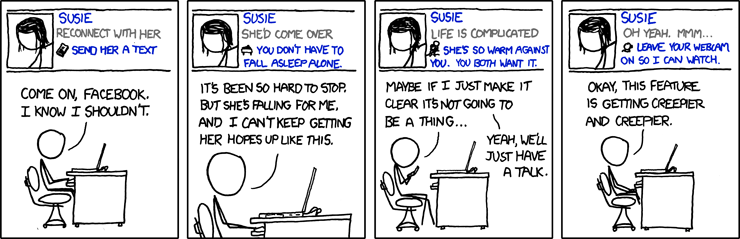
(I can't resist including xkcd's take on Facebook's prodding suggestions...)